Text
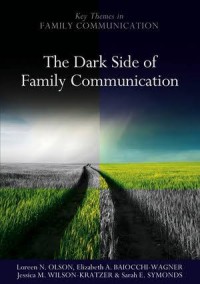
The dark side of family communication
The Dark Side of Family Communication examines the negative and complex aspects of family communication that can affect relationships among family members. The book explains that communication within families is not always positive and harmonious; it may also involve conflict, misunderstanding, manipulation, avoidance, emotional pressure, and various forms of interaction that can potentially damage the quality of family relationships.
The text covers theories and concepts of family communication, dysfunctional interaction patterns, family conflict, family secrets, deception, verbal aggression, power imbalances, emotion management, and the effects of negative communication on individual development and family dynamics. The authors explore how social, cultural, and psychological factors contribute to the emergence of the darker side of family communication and influence the ways family members interact with one another.
By integrating theoretical perspectives with empirical research and practical examples, the book provides a comprehensive understanding of the challenges and complexities that families may encounter in their communication processes. It is a valuable resource for students and scholars of communication, family studies, psychology, and sociology, as well as practitioners interested in understanding and addressing problematic communication patterns within family relationships.
Availability
Detail Information
- Series Title
-
-
- Call Number
-
306.87 OLS d
- Publisher
- Cambridge : Polity Press., 2012
- Collation
-
xii, 166 p. : ill. ; 22 cm.
- Language
-
English
- ISBN/ISSN
-
978-0-7456-4798-2
- Classification
-
306.87
- Content Type
-
-
- Media Type
-
-
- Carrier Type
-
-
- Edition
-
-
- Subject(s)
- Specific Detail Info
-
-
- Statement of Responsibility
-
-
Other version/related
No other version available
File Attachment
Comments
You must be logged in to post a comment
 Computer Science, Information & General Works
  Philosophy & Psychology
  Religion
  Social Sciences
  Language
  Pure Science
  Applied Sciences
  Art & Recreation
  Literature
  History & Geography